Market clarity
A national jobs report is not a job-search forecast
A reassuring headline can still conceal a hard search. National jobs data are revised, broad, and incomplete; candidates need to track hiring movement in the roles they can actually win.
By Applyy Research · · 7 min read

A national jobs report is a dashboard, not a forecast for one person's job search.
The June employment report showed a modest payroll gain of 57,000 and a 4.2% unemployment rate. That describes an economy at national scale. It cannot tell a candidate how quickly companies in their field, city, or level are actually hiring.
That distinction matters. A candidate can encounter a very hard search even while a headline report sounds reassuring.
The problem is not one fabricated number. It is a thin picture.
Claims that the jobs report is "faked" need evidence of deliberate falsification. We did not find that evidence. What the data do show is a measurement system that is necessarily incomplete and regularly revised.
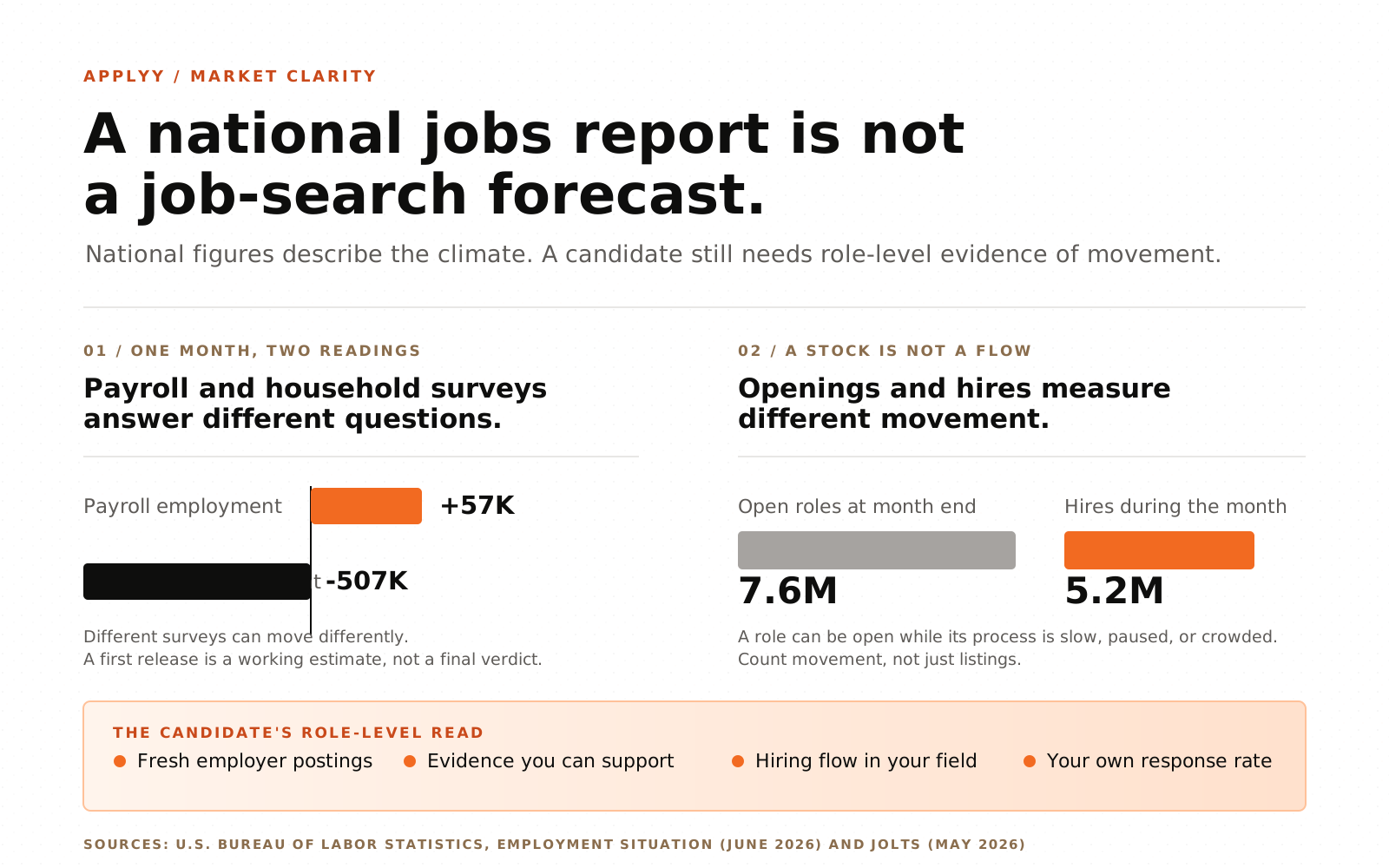
The headline release combines two different sample surveys. The household survey records labor force status and unemployment. The establishment survey records payroll jobs. In June, the establishment survey showed 57,000 more payroll jobs, while the household survey showed employment down 507,000 and the labor force down 720,000. One month of movement does not prove the labor market is deteriorating. It does show why a single headline cannot settle the question.
The payroll estimate is also preliminary. BLS revises the first estimate twice as more responses arrive and then re-benchmarks it annually to lagged unemployment-insurance tax records. Its February 2026 benchmark revision lowered the March 2025 nonfarm employment level by 861,000. Revisions are a normal quality-control feature, not proof of deception. But they are a reason to treat a first release as a working estimate, not a final verdict.
Count movement, not just openings
Job openings are a stock: roles open on the last business day of a month. Hires are a flow: people who moved onto payroll during that month. Those are different questions.
In May, JOLTS reported 7.6 million openings and 5.2 million hires. It also reported 3.1 million quits, a 1.9% quits rate, and 5.1 million total separations. The figures were broadly unchanged. A large national openings number therefore does not mean a recruiter is moving quickly on a role or that a qualified candidate will see a fast process.
The same release shows a market where job movement can be limited even when it has not collapsed. For a candidate, that can mean fewer clean chances to change jobs, more competition for the roles that are moving, and longer cycles before a team commits.
The average can hide a hard search
The official unemployment rate counts people who are jobless, available, and actively looking. It does not include everyone who says they want work but has stopped looking recently. BLS publishes broader measures for that reason. In June, 1.9 million people had been unemployed for 27 weeks or more, up 286,000 over the year and 27.3% of all unemployed people.
These measures do not prove the national data are dishonest. They show why "healthy" is too blunt a word. National measures smooth over occupation, seniority, location, wage, and company differences - the variables that actually shape a search.
Make your own role-level read
A candidate needs a more specific dashboard:
- fresh postings on direct employer career pages;
- a realistic count of roles whose requirements they can support with evidence;
- hiring flow in their field, not just national openings;
- roles that have stayed open long enough to signal a slow or paused process;
- response and interview rates from their own best-fit applications.
The practical response is not to panic-apply. It is to apply where the case is legible: work that matches your experience, proof, industry context, and likely ramp time. National reports can describe the weather. Your search system still has to identify the roads that are actually open.
Put this research to work
Use the part of Applyy that best fits your next job-search decision.
- Job search tool: Find jobs, evaluate fit, tailor materials, and track applications in one job search tool designed for focused, evidence-backed applications.
- AI job search: Use Applyy to find better-fit jobs, tailor applications from evidence you approve, and review every submission in one AI-assisted job search workflow.
- Application tracker: Use Applyy's job application tracker to organize roles, tailored documents, application progress, and next actions without losing listing context.
Sources
- U.S. Bureau of Labor Statistics: Employment Situation, June 2026
- U.S. Bureau of Labor Statistics: Job Openings and Labor Turnover, May 2026
- U.S. Bureau of Labor Statistics: CES Frequently Asked Questions: revisions and benchmarking
- U.S. Bureau of Labor Statistics: Employment Situation FAQs: who is counted as unemployed